1

The Fox and the Geese; and The Wonderful History of Henny-Penny — Text and Context
7
1
Project Gutenberg
2007
Animals -- Juvenile fiction; Children's stories; Nursery rhymes; Conduct of life -- Juvenile poetry; Foxes -- Juvenile poetry; Geese -- Juvenile poetry
Readers of public-domain and historical texts
Project Gutenberg digital edition
en
Edition facts
Words: 5,356
Reading time: 24 min
Text sections: 1
Source:
Project Gutenberg record #22611
Two verse tales in which disobedient geese meet a fox, and Henny-Penny leads a panic-stricken procession of fowl. The language shifts from moralising couplets to cumulative, rhythmic repetition, with Harrison Weir's illustrations punctuating the action.
Editorial Edition Score
4.4/5
★★★★★
★★★★★
Calculated from edition completeness, EPUB availability, text structure and catalogue metadata. Not a user rating.
Edition quality
The two tales in this volume share a common structural device: a chain of events set in motion by a single, unheeded warning. In The Fox and the Geese, a dying goose instructs her daughters to build houses of stone or brick with tiled roofs, but each daughter in turn chooses a cheaper, flimsier construction. The narrative proceeds through a series of near-identical episodes, each varying only the building material and the fox’s method of entry. The second tale, The Wonderful History of Henny-Penny, reverses the pattern: an acorn falling on Henny-Penny’s head triggers a growing procession of alarmed fowl, each repeating the same formulaic announcement. Both stories rely on repetition and incremental variation to build tension, though the moral conclusion of the first is explicit, while the second ends in a comic anticlimax.
Repetition as Narrative Engine
Both tales are built on iterative structures. In The Fox and the Geese, the three sisters—Gobble, Goosey, and Ganderee—each build a house that the fox eventually breaches. The descriptions of the houses follow a pattern: material, roof type, and the fox’s method of entry. For example, Gobble uses boards and a box lid; Goosey uses brick but thatches with straw; Ganderee presumably uses stone and tiles. The fox’s attacks are similarly formulaic: he scratches, jumps, or climbs, and the narrator reports the outcome in rhyming couplets. This repetition makes the story predictable, which suits a moral lesson about the consequences of disobedience.
In Henny-Penny, the repetition is cumulative and rhythmic. Each new character—Henny-Penny, Cocky-Locky, Ducky-Daddles, Goosey-Poosey, Turkey-Lurkey—joins the procession by repeating the same line: “The sky is falling! I must go and tell the King.” The narrative accumulates names and actions in a chant-like manner, building momentum until the fox intervenes. The repetition here serves a different purpose: it creates a sense of escalating panic and absurdity, as each bird unquestioningly follows the last.
Voice and Moral Tone
The narrator’s voice in The Fox and the Geese is overtly moralising. The opening stanza establishes the mother goose’s dying words as a warning, and the narrator comments on each sister’s folly: “But Gobble, the youngest, I grieve to say, / Soon came to a very bad end, / Because she preferred her own silly way.” The tone is that of a cautionary tale, with direct addresses to the reader implied by the moral framework. The fox is portrayed as a cunning predator, and the geese’s deaths are described without sentimentality: “Ere he snapped off her lily-white head.”
In contrast, Henny-Penny adopts a more playful, almost farcical tone. The narrator does not moralise; instead, the humour arises from the characters’ gullibility and the escalating absurdity of the procession. The fox, rather than being a villain, is a trickster who lures the birds into his den. The story ends with the fox and his family eating the birds, but the tone remains light, as if the outcome is a natural consequence of the birds’ foolishness rather than a punishment. The difference in voice suggests that the two tales, though paired, operate in different registers: one is a fable with an explicit lesson, the other a cumulative folk tale with a comic punchline.
Pacing Through Structure and Illustration
The pacing of each tale is determined by its structural repetition. In The Fox and the Geese, the three episodes of house-building and fox-attack create a steady, predictable rhythm. Each episode is roughly the same length, and the tension is resolved quickly: the fox succeeds, and the goose dies. The story does not linger on description; action is compressed into a few stanzas. The result is a brisk, almost mechanical progression that reinforces the moral: disobedience leads swiftly to disaster.
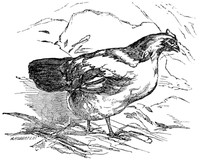
Henny-Penny builds pace through accumulation. Each new character adds a line to the procession, and the repetition of “The sky is falling!” becomes more frantic. The story accelerates as the group grows, until the fox’s appearance introduces a sudden halt. The illustrations by Harrison Weir, mentioned in the title page, likely punctuate these moments, though the text itself does not describe them. The cumulative structure creates a sense of inevitability, but the ending—the fox eating the birds—is abrupt and anticlimactic, undercutting the panic. This shift in pace from building tension to sudden resolution is a key feature of the tale.
Readers may find it useful to compare the two tales side by side, noting how the same basic pattern—repetition with variation—produces different effects. The first tale uses repetition to reinforce a moral lesson; the second uses it to generate comic momentum. Pay attention to the rhythm of the verse, especially the way line lengths and rhymes change as the stories progress. The illustrations, though not reproduced here, were clearly designed to highlight key moments of action and character, and imagining them can deepen one’s sense of the pacing.
Reader reflection
Your personal reading reflection
Build a private reading journal entry for this title.
Your progress
0
/
10
2
What was your overall reaction to the book?
3
Would you recommend this book to another reader?
4
How easy was the book to follow?
5
What was the strongest part of the book?
6
Is this a title worth rereading?
7
Did the book give you something worth debating?
8
How understandable was the text?
9
In one sentence, what did you learn?
10