1

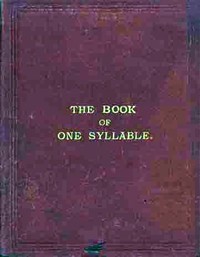
The book of one syllable — A Reader’s Guide
8
1
Project Gutenberg
2007
Conduct of life -- Juvenile fiction; Children's stories
Readers of public-domain and historical texts
Project Gutenberg digital edition
en
Edition facts
Words: 19,298
Reading time: 84 min
Text sections: 2
Source:
Project Gutenberg record #23453
Esther Bakewell's 19th-century children's book uses only one-syllable words to tell moral tales. The strict vocabulary constraint shapes a clipped, direct narrative voice, while shifts between didactic commentary and tense adventure scenes create a distinctive reading experience.
Esther Bakewell's The Book of One Syllable (1860s) is a deliberate experiment in constrained vocabulary: every word in its tales consists of a single syllable. This self-imposed rule governs not only the lexicon but also the rhythm and tone of the prose. The opening story, “The Wreck of a Feast,” begins with a moral lecture on self-rule before plunging into a narrative of temptation and consequence, revealing how the monosyllabic constraint shapes both instruction and incident.
The book's preface clarifies its intended reader: not a child just learning to spell, but one who already knows such words at sight. The goal is to let the child “be led on and on till he comes to the end” without stopping to decode. This editorial note examines how Bakewell's language, narrative voice, and changes in pace work within that tight verbal frame.
The Monosyllabic Constraint and Its Effects on Voice
The rule of one syllable forces Bakewell into a stark, repetitive syntax. Sentences are short and often paratactic: “They saw grand shows, and stalls full of nice things. They had each of them brought half a crown; but the half-crowns were soon spent, and they would have been glad of more.” The vocabulary is drawn from a core of Anglo-Saxon words—wish, wrong, self, rule, taste, cake, fruit—with few Latinate terms. This gives the narrator a plain, almost blunt tone, as in the opening of “The Wreck of a Feast”: “What a sad sight it is to see a young child who does not know how to keep a check on the wish that tempts him to do wrong.” The voice is that of a firm but caring adult, speaking directly to the child reader. The constraint also eliminates most abstract or complex moral vocabulary; instead, moral concepts are rendered through concrete actions and consequences.
Shifts in Pace: From Didacticism to Dramatic Tension
Bakewell varies the pace markedly between moral exposition and narrative action. The didactic passages move slowly, with repeated injunctions: “The first rule that they who love a child should teach him, is the rule of self.” These sections feel deliberate and weighty. In contrast, the adventure tales accelerate into brisk, tense sequences. In “The Lost Ones,” the children’s illicit trip to the fair leads to a kidnapping. The prose becomes terse and urgent: “This Strange One could bear it no more, and she told them that she would tie up their mouths, but they did not seem to mind. At last she did tie their mouths; and she led them on, and on, and did not stop till she came to a wild heath.” The repetition of “on, and on” mimics the relentless journey. The pace quickens further when Paul breaks his string and leads his siblings through the dark heath. These shifts keep the young reader engaged, alternating between instruction and suspense.
Recurring Details and the Moral Framework
Several recurring details tie the tales together. The most prominent is the emphasis on self-rule as the foundational virtue. In “The Wreck of a Feast,” the narrator states that “the want of this self-rule is the cause of so much that is bad in the world.” This theme reappears in “The Lost Ones,” where the children’s disobedience—going to the fair against orders—directly causes their ordeal. The phrase “they knew, too, that they had brought this on them selves” echoes the earlier moral. Another recurring element is the figure of the “Strange One,” a mysterious adult who punishes the children. This character appears without explanation or backstory, heightening the sense of threat. The setting also repeats: wild heaths, dark nights, and lonely roads create a consistent atmosphere of peril. These details reinforce the book’s moral lessons without requiring complex vocabulary.
Readers may find it useful to read the tales aloud, as the monosyllabic rhythm becomes more apparent in spoken form. Notice how Bakewell uses repetition and short sentences to build tension, and how the moral passages slow the pace to allow reflection. The book rewards attention to its linguistic constraints, which shape every aspect of the narrative.
Reader reflection
What did you think of this book?
Answer a few questions and save a private reflection on this device.
Your progress
0
/
10
2
Was reading this book enjoyable?
3
Would you recommend this book to another reader?
4
How easy was the book to follow?
5
Would you start a conversation about this book?
6
What was its emotional impact?
7
How understandable was the text?
8
Which element worked best for you?
9
What did this book teach you most?
10