1

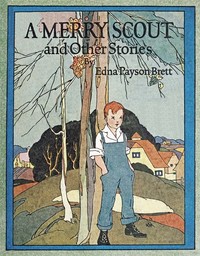
A Merry Scout — Edition Insights
8
1
Project Gutenberg
2021
Children's stories; Children -- Juvenile fiction
Readers of public-domain and historical texts
Project Gutenberg digital edition
en
Edition facts
Words: 10,548
Reading time: 46 min
Text sections: 7
Source:
Project Gutenberg record #66888
In this 1922 children's story, nine-year-old Davy counts the months until he can become a real scout, while other tales follow Robert's runaway attempt and Sandy's valentine. The author uses playful animal dialogue and a child's earnest voice to explore youthful determination and mishap.
Editorial Edition Score
4.6/5
★★★★★
★★★★★
Calculated from edition completeness, EPUB availability, text structure and catalogue metadata. Not a user rating.
Edition quality
Edna Payson Brett opens A Merry Scout with a precise, sympathetic focus on Davy's age: "He was only nine and a half, you see, and that meant two years and six months of waiting." The narrator's direct address—"you see"—invites the reader into Davy's frustration, while the exact countdown establishes a child's perspective on time. Throughout the excerpts, Brett renders children's inner logic through concrete details: Davy designs his own secret badge and swears the scout oath alone before a mirror, pinning the badge "under his jacket, right over his heart." The prose balances earnestness with gentle humor, as when Robert's flight from home is punctuated by animals that seem to scold him—a rooster screams "What-you-going-to-do-oo?" and a frog calls "Bubby-gu-hum!" These touches give the world a whimsical, slightly mischievous tone that matches the title's promise of merriment.
A Child's Internal Clock
Brett anchors Davy's story in a precise temporal framework: "two years and six months of waiting—oh, such long waiting." The repetition of "waiting" and the phrase "counting the time" recur throughout the opening, establishing a rhythm of anticipation. Davy's internal countdown is not merely stated but dramatized through his actions—he "determined to take matters into his own hands" by performing the oath alone. The author avoids abstract statements about patience; instead, she shows Davy's solution: a self-administered ceremony before a looking-glass. This concrete ritual, complete with a hidden badge, reveals how children adapt adult structures to their own scale. The waiting is also tied to seasonal markers—"late in December," "the summer before"—grounding the emotional timeline in observable changes. Brett's handling of time gives the narrative a forward momentum that mirrors Davy's own eagerness.
Animal Interlocutors and Moral Commentary
In "Robert's Adventure," Brett gives farm animals distinct voices that function as a chorus of conscience. When Robert tries to run away, the white rooster "screamed right out, so loud that Robert feared the whole village would hear" and calls "What-you-going-to-do-oo?" The cow Lady Ann responds with a drawn-out "Oo-oo! oo-oo!" and the sheep bleat "Ba-ad! Ba-ad!"—a pun that Robert himself rejects: "No, I'm not bad, either!" These exchanges are not mere decoration; they externalize Robert's internal conflict. The animals' sounds are rendered as quasi-speech, bridging the gap between natural noise and human language. Brett uses this technique to create a world where nature observes and comments on the child's choices, adding a layer of folk-tale logic to the domestic setting. The frog's "Bubby-gu-hum!" is the most absurd example, yet it prompts Robert to argue back, revealing his stubbornness and fear.
The Weight of Earnest Vows
Davy's self-administered oath is treated with complete seriousness by the narrative: "he solemnly swore to the oath, all by himself; then he pinned under his jacket, right over his heart, a secret badge of his own designing." The words "solemnly" and "secret" elevate the act, while the detail of the badge's placement—"over his heart"—emphasizes its emotional significance. Brett does not mock this makeshift ceremony; instead, she reports that Davy "considered himself as honor-bound to the oath as any scout living." The contrast between the child's earnestness and the improvised nature of the ritual creates a gentle pathos. Similarly, Robert's runaway plan is built on a child's flawed logic: he imagines Nurse will give him candy money and that his parents will beg him to return. Brett presents these calculations without condescension, allowing the reader to see both the ingenuity and the naivety. The authorial choice to treat childhood vows and schemes with respect gives the stories their emotional weight.
Setting as Emotional Landscape
Brett uses seasonal and physical details to mirror the characters' moods. The story opens with a snowstorm that clears "about noon," and Davy "hailed it with whoops of delight" because shoveling walks could earn Christmas money. The snow is not just weather; it is opportunity. Later, Robert's flight takes place under a "blazing" summer sun, and his discomfort is registered through the landscape: "How hot the sun was! And how tired and bruised his poor feet were getting!" The shift from winter to summer across the stories underscores different kinds of longing—Davy's hopeful waiting versus Robert's impulsive escape. The brook where Robert rests is described as "nice and shady," but it becomes the site of his fearful encounter with the frog. Brett's settings are never neutral; they participate in the emotional arc. The contrast between the cozy farmyard and the open road, or between the snowy neighborhood and the sunny fields, gives each adventure a distinct sensory texture that reinforces the child's perspective.
Brett's prose rewards attention to small gestures: a badge pinned under a jacket, a pair of Sunday shoes swung over a shoulder, a frog's call mistaken for a scolding. These details accumulate into a portrait of childhood that is neither sentimental nor ironic. Readers may notice how often the author lets animals speak, how precisely she marks the passage of time, and how seriously she takes a child's homemade rituals. The stories invite a slow reading that savors these choices rather than racing toward a plot resolution.
Reader reflection
How will you remember this book?
Save your reaction, strongest insight, and memorable passage.
Your progress
0
/
10
2
How did the book work for you overall?
3
Would you recommend this book to another reader?
4
What was the reading difficulty like?
5
How distinctive were its ideas or approach?
6
Do you expect to return to this book?
7
Would this book work well in a reading group?
8
Did the story or argument move comfortably?
9
What changed or sharpened your thinking?
10