1

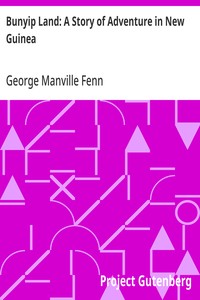
Bunyip Land: A Story of Adventure in New Guinea — Reading Notes
6
1
Project Gutenberg
2007
Friendship -- Juvenile fiction; Birds -- Juvenile fiction; Sailing -- Juvenile fiction; Adventure and adventurers -- Juvenile fiction; Voyages and travels -- Juvenile fiction; Ship captains -- Juvenile fiction; Rescues -- Juvenile fiction; Physicians -- Juvenile fiction; Hunting -- Juvenile fiction; Sick -- Juvenile fiction; Papua -- Juvenile fiction
Readers of public-domain and historical texts
Project Gutenberg digital edition
en
Edition facts
Words: 109,511
Reading time: 477 min
Text sections: 10
Source:
Project Gutenberg record #21301
In this 19th-century adventure, young Joseph defies his nurse to search for his botanist father lost in New Guinea. The excerpts show a narrative driven by maps, native companions, and a tense siege with arrows and a moving bush, but the catalog subjects like 'Birds' and 'Sailing' are barely evident.
Editorial Edition Score
4.8/5
★★★★★
★★★★★
Calculated from edition completeness, EPUB availability, text structure and catalogue metadata. Not a user rating.
Edition quality
The opening chapter of Bunyip Land introduces Joseph, a boy bent over a map, planning to rescue his father—a botanist lost in New Guinea. His nurse scolds him for his obsession, calling the father's plant-collecting “mad” and Joseph's association with a black companion “low.” The dialogue reveals a tension between domestic caution and adventurous ambition, with Joseph insisting his father is a prisoner, not dead. The map is a recurring prop, symbolizing the pull of unknown territory.
A Map, a Nurse, and a Native Companion
The excerpts open with Nurse Brown’s complaint about Joseph “running your finger over that map thing.” This map is the catalyst for the plot: Joseph declares, “I mean to go and find my poor dear father.” The nurse’s resistance—calling the father’s botany “furren buttercups and daisies”—grounds the adventure in a domestic reality. Joseph defends his companion Jimmy as “a native gentleman,” contrasting the nurse’s view of him as “dirty black.” This early exchange establishes a central dynamic: the hero’s resolve against caution, and the racial attitudes of the period. The map, not yet shown in action, is the story’s compass.
Siege, Thirst, and a Moving Bush
Later excerpts depict a siege. Joseph, with allies Ti-hi and Aroo, is pinned down by savages. The tension centers on a “great green bush” that advances like “a nightmare.” Joseph cannot shoot, “helplessly fascinated.” The bush proves to be a shield for a fighter who joins them, bringing water—a crucial relief: “like nectar to us, parched and half-dying with thirst.” The episode shows Fenn’s use of natural cover as a deceptive threat, and the importance of water in a tropical setting. The enemy’s arrows and stones create a physical, immediate danger, with the group’s survival hinging on small resources.
Catalog Subjects vs. Actual Content
The Project Gutenberg catalog lists subjects including Birds, Sailing, Ship captains, and Physicians. Yet the excerpts contain no birds, no ships, no captains, and no doctors. The adventure is land-based, in New Guinea’s mountains and gorges. The only water is a calabash. The catalog likely reflects the full novel’s range—perhaps a sea voyage precedes the jungle—but the excerpts focus on a rescue mission and a siege. Readers expecting ornithology or nautical detail will find instead a story of pursuit, thirst, and native alliances. The gap between catalog and text is notable.
The excerpts offer a narrow window into a longer novel. The map, the nurse’s objections, and the siege with a moving bush are specific, vivid moments. Readers should note that the catalog subjects may not align with these early chapters; the full book may introduce other elements. Approach the text as a period adventure with a strong domestic frame and a focus on survival in a hostile landscape.
Reader reflection
Record your reading impressions
A brief reflection can help important ideas stay with you longer.
Your progress
0
/
10
2
How did the book work for you overall?
3
Is this a title you would suggest to others?
4
How much effort did this book require?
5
What did you appreciate most?
6
Was the book what you thought it would be?
7
Did any part of the book stay with you emotionally?
8
How personally connected did you feel to the book?
9
What changed or sharpened your thinking?
10