1

The Pleasures of the Country: Simple Stories for Young People — Context and Discussion
9
1
Project Gutenberg
2011
Children's stories; Country life -- England -- Juvenile fiction
Readers of public-domain and historical texts
Project Gutenberg digital edition
en
Edition facts
Words: 26,929
Reading time: 118 min
Text sections: 3
Source:
Project Gutenberg record #37013
This editorial note examines how the opening, middle, and later excerpts of Mrs. Harriet Myrtle's 'The Pleasures of the Country' guide a first reading, focusing on the interplay between rural setting, moral lessons, and child characters' responsibilities.
Editorial Edition Score
4.6/5
★★★★★
★★★★★
Calculated from edition completeness, EPUB availability, text structure and catalogue metadata. Not a user rating.
Edition quality
The opening excerpt introduces Edward and Kate in a country town with an old church and ivy-covered tower, establishing a serene yet structured environment. Their fascination with the Old Hall, a deserted manor house, is fueled by carpenter John Wilson's descriptions of its painted windows and carved ceilings. This sets up a pattern of curiosity and gradual revelation, where the children's desire to explore is mediated by adult permission and practical knowledge.
The narrative voice is direct and instructional, blending descriptive detail with moral undertones. The children's longing to see the garden and hall is not merely whimsical; it is tied to John's craftsmanship and the promise of future restoration. This opening primes readers to expect a story where discovery is earned through patience and respect for boundaries.
The Role of Adult Mentors
The excerpts consistently position adults as guides rather than mere authority figures. John Wilson, the carpenter, is a friend who teaches practical skills like sawing and planing while sharing stories of the Old Hall. His permission, obtained through the housekeeper Mrs. Hollis, enables the children's visit. Later, the mother in the middle excerpt becomes a moral compass after Rose and Harry neglect their duty to watch Fairy the hen. She does not scold harshly but uses the failure to teach a lesson: "Whatever duty you have to perform let that be your first concern."
This pattern suggests that the book values learning through experience under benevolent supervision. The adults do not shield children from consequences but help them reflect. Readers can observe how each episode builds responsibility, from the initial excitement of exploration to the sobering aftermath of neglect.
Play as a Mirror for Real Work
The middle excerpt features an elaborate pretend shop where Harry and Rose use stones as loaves, willow twigs as butter, and orange-peel scales. This play mimics adult commerce, with Rose acting as a farmer's wife bargaining for supplies. Yet the game is interrupted by the real-world consequence of their forgotten duty: Fairy's eggs grow cold. The shift from imaginative play to crisis is abrupt, highlighting how the children's make-believe world cannot replace their actual responsibilities.
Myrtle uses this contrast to underscore a recurring theme: play is valuable but must be balanced with diligence. The children's later inability to eat breakfast and their solemn walk with their mother show that the lesson has sunk in. Readers can track how the book uses everyday activities—shopping, farming, carpentry—to teach practical ethics without heavy-handed moralizing.
Descriptive Details of Rural Life
The excerpts are rich with specific, tangible details that ground the stories in a recognizable English countryside. The opening describes the town's "wide streets" and "old church that had large trees round it, and ivy growing up the tower." The Old Hall's pavilion is "partly gone to ruin," with roses and jasmines hanging over the wall. Later, the hen-house setting includes details like "warm eggs" and Fairy "ruffling her feathers." These observations are not decorative; they create a sensory world that children can visualize.
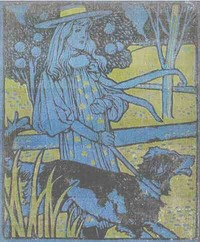
John Gilbert's illustrations, mentioned in the title page, likely complement these descriptions. The text's focus on tangible objects—boats, bookcases, scales, crockery—suggests that the book encourages readers to notice their own surroundings. The carpenter's trade and the children's play with natural materials reinforce a hands-on, observational approach to learning.
Moral Consequences and Emotional Realism
When Rose and Harry realize their neglect, their reaction is notably emotional: Rose cries, Harry's voice falters, and they cannot eat. The mother's sadness is visible, and the children express remorse directly: "You will not be able to trust us any more." This emotional honesty is a key feature of the excerpts. The narrative does not minimize the disappointment but allows the children to sit with their feelings before being offered a chance to redeem themselves the next morning.
This pattern—mistake, regret, forgiveness, renewed effort—appears to structure the book's moral lessons. Readers can anticipate that each story will present a similar arc, where children face a test of responsibility and learn through failure. The lack of immediate happy endings (the eggs remain cold) adds realism; the lesson is internalized rather than magically resolved.
These excerpts reveal a book that combines pastoral charm with clear ethical instruction. The children's world is one where curiosity leads to adventure, but where every pleasure is balanced by a duty. For a first reading, pay attention to how Myrtle uses small, concrete objects—a bell, a nest, a set of scales—to anchor larger lessons. The stories reward careful observation of both the natural setting and the characters' emotional growth.
Reader reflection
Your personal reading reflection
Build a private reading journal entry for this title.
Your progress
0
/
10
2
Did this book hold your interest?
3
Would you pass this book on to a friend?
4
Did the language feel accessible?
5
Did the book deliver what you hoped for?
6
Could you follow the author’s main argument?
7
Would you like to discuss this book with someone?
8
Did you relate to its people, ideas, or situations?
9
In one sentence, what did you learn?
10