1

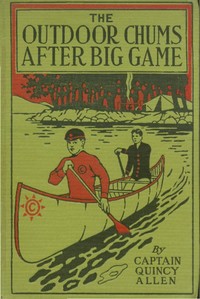
The Outdoor Chums After Big Game; Or, Perilous Adventures in the Wilderness — Reading Companion
5
1
Project Gutenberg
2005
Boys -- Juvenile fiction; Camping -- Juvenile fiction; Adventure and adventurers -- Juvenile fiction; Outdoor life -- Juvenile fiction; Hunting -- Juvenile fiction; Northwest, Pacific -- Juvenile fiction
Readers of public-domain and historical texts
Project Gutenberg digital edition
en
Edition facts
Words: 48,458
Reading time: 211 min
Text sections: 6
Source:
Project Gutenberg record #15188
This editorial note examines how Quincy Allen structures the Outdoor Chums' wilderness hunt through alternating scenes of travel, campfire talk, and sudden danger, with recurring images of boats, rifles, and glowing animal eyes that tighten the narrative.
The Outdoor Chums After Big Game opens not in the wilderness but on Camalot Lake, where the four boys—Frank, Bluff, Jerry, and Will—are sailing and canoeing. The first chapter, “Glorious News,” establishes a pattern of movement between water and land that continues throughout the book. Frank arrives in his boat Jupiter “like a streak,” and the boys’ banter about examinations and adventures sets a tone of eager anticipation. This lakeside prologue quickly gives way to a westward journey, but the author repeatedly returns to scenes of transit—by motorcycle, train, horse, and raft—that frame the hunting episodes.
Boats, Breezes, and Beginnings
The first chapter relies heavily on nautical detail: a “double canoe” with “flapping sails,” a “dainty fifteen-foot cedar craft,” and the named boat Jupiter. These vessels are not mere transportation; they define the boys’ camaraderie and skill. Bluff manipulates his craft with practiced ease, and the breeze is described as “too good to be wasted loafing.” This emphasis on wind and watercraft establishes the chums as competent outdoorsmen before they ever face a grizzly. The lake setting also provides a controlled contrast to the later wilderness—a safe space where news is delivered and plans are made. By opening on water, Allen signals that the boys’ adventures will be measured against their familiarity with nature’s elements, and that their real test lies in leaving this familiar element behind.
Campfire Conversations and Looming Threats
Once the group reaches the Valley Ranch and later camps in the wilderness, the narrative slows for extended campfire scenes. These passages serve as information exchanges, where the cowboy guide Billy and the older Mr. Mabie recount past encounters with panthers and grizzlies. Billy’s arms are “all scarred up from deep cuts made by the claws of a panther,” a detail that lends authority to his warnings. The campfire talk is punctuated by specific, almost folkloric observations: panthers’ eyes are “always yellow,” and a hungry painter “ain’t afraid of anythin’ but fire.” These details build suspense, as the reader—like the boys—begins to expect an attack. The structure of these scenes—relaxed conversation suddenly interrupted by a threat—recurs throughout the book, creating a rhythm of calm and crisis.
The Panther’s Yellow Eyes
One of the most striking recurring images is the glowing eyes of a panther seen from camp. In the excerpt, Bluff points and says, “Like those yonder,” and every eye turns to see “twin glowing eyes among those bushes.” The eyes are described as having “all the attributes of the cat tribe.” This moment is carefully staged: the cowboy has just finished describing panther behavior, and the beast appears as if on cue. The eyes become a visual shorthand for danger—unseen, predatory, and patient. When Bluff fires prematurely, the panther, “infuriated by receiving a sudden, painful wound, launched straight out, and landed in the midst of the campers.” The attack is sudden and chaotic, with everyone scrambling. Allen uses the eyes to signal the transition from talk to action, a technique he repeats to maintain tension.
Movement and Momentum
The book’s structure is built on rapid shifts between scenes of travel and moments of intense action. Chapter titles like “Westward Bound,” “At the Valley Ranch,” “In the Rapids,” and “The Stampede” indicate a constant forward motion. Even within chapters, the narrative moves quickly: a conversation about panthers is interrupted by the beast’s appearance; a quiet camp scene gives way to a grizzly attack. Allen often uses a single sentence to pivot from description to danger, as when the cowboy’s calm reply—“Like those yonder, do you mean?”—is followed by the discovery of the eyes. This technique keeps the reader off-balance, mirroring the unpredictability of the wilderness. The boys themselves are rarely stationary for long; they are always planning the next leg of the journey, repairing gear, or responding to a threat.
Readers will find that the book’s effectiveness depends less on character development than on the careful alternation of peaceful travel and sudden peril. Pay attention to how Allen uses the environment—lakes, rapids, forests—as both backdrop and active participant in the story. The recurring image of glowing eyes, whether from panther or campfire, serves as a reminder that danger is never far away, even when the boys are laughing around the fire.
Reader reflection
Your personal reading reflection
Build a private reading journal entry for this title.
Your progress
0
/
10
2
Was reading this book enjoyable?
3
Would you recommend this book to another reader?
4
How easy was the book to follow?
5
How distinctive were its ideas or approach?
6
Could you apply anything you learned?
7
How personally connected did you feel to the book?
8
Was the book moving at the right speed?
9
In one sentence, what did you learn?
10