1

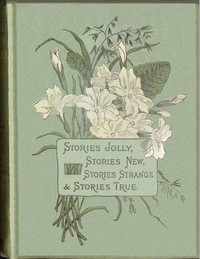
Stories jolly: stories new: stories strange & stories true — Inside the Classic
20
5
Project Gutenberg
2025
Children's stories; Children -- Conduct of life -- Juvenile fiction
Readers of public-domain and historical texts
Project Gutenberg digital edition
en
Edition facts
Words: 71,432
Reading time: 311 min
Text sections: 8
Source:
Project Gutenberg record #76139
This 1889 anthology of 22 new tales for children features a wide range of narrative voices, from the ornate description of Fanny Barry's 'The Fountain Angel' to the comic grotesquerie of the two-headed giant Grimbo in 'The Giant Fishers of Hertzenberg.' The collection mixes moral instruction with adventure, fantasy, and domestic realism.
Editorial Edition Score
4.7/5
★★★★★
★★★★★
Calculated from edition completeness, EPUB availability, text structure and catalogue metadata. Not a user rating.
Edition quality
The collection opens with Fanny Barry's 'The Fountain Angel,' where the prose is deliberately ornate: the water 'fell down with a soft plash into a fluted shell beneath' and 'rippled again into a marble basin.' This measured, sensory style contrasts sharply with the comic violence of 'The Giant Fishers of Hertzenberg,' in which the giant Grimbo—equipped with two interchangeable heads—'unscrewed the smiling unoffending head with a vicious jerk' and threw it across the room. The editor's preface notes that fairy tales were mostly excluded, yet the volume includes stories that blend fantasy with moral lessons, such as the giant's wife secretly aiding a prisoner, and the rope-maker's clever use of steel-wire rope to protect himself.
Contrasting Narrative Voices
The anthology's range of authors produces markedly different narrative tones. Fanny Barry's prose in 'The Fountain Angel' is lush and unhurried, with sentences that linger on visual details: the orange trees 'in tubs,' the white benches 'with banks of flowering plants behind them.' This descriptive richness establishes a serene, almost painterly setting. In contrast, the anonymous author of 'The Giant Fishers of Hertzenberg' adopts a boisterous, exaggerated voice. The giant's dialogue is punctuated with multiple exclamation marks and threats: 'I'll kill and stew that cheating rope-maker, I will!' The narrator also inserts wry asides, noting that working himself 'into a towering passion' was 'an amusement that he was very fond of indulging in.' This tonal variety means the reader moves from quiet observation to broad comedy within a few pages.
Pacing Through Physical Description
Pacing shifts noticeably between stories, often controlled by the density of physical description. In 'The Fountain Angel,' the slow accumulation of setting details—the fountain's horn, the fluted shell, the marble basin, the grass, the flower beds, the orange trees—creates a deliberate, almost static opening. Action is deferred. By contrast, 'The Giant Fishers' accelerates through rapid, physical comedy: the giant's head is unscrewed and thrown, his wife is sent 'upstairs to fetch the other one,' and the rope-maker flees 'with a sickly smile and trembling limbs.' The narrative moves quickly from threat to chase to preparation for confrontation. The rope-maker's pre-woven steel-wire rope, 'provided with a slip-knot and a noose,' is introduced as a payoff, tightening the suspense. This variation in descriptive density gives the collection an uneven but engaging rhythm.
Recurring Motifs of Escape and Deception
Several stories share motifs of escape and clever deception. In 'The Giant Fishers,' the prisoner escapes with the giant's wife's help, and the rope-maker has secretly prepared a reinforced rope to protect himself. The giant's two heads—one good-natured, one scowling—literalize the theme of deception: the head 'grumbling away to itself in the drawer' while the other is worn. In 'The Fountain Angel,' the setting itself suggests a kind of escape into beauty. The editor's preface notes that fairy tales were mostly excluded, yet these stories still rely on fantastic elements (a two-headed giant, a child-figure fountain) to explore moral lessons about honesty, courage, and resourcefulness. The rope-maker's 'guilty conscience' and the giant's rage at being cheated reinforce a pattern where deception is punished or outwitted.
Readers may find it useful to note the authors' names as they move through the collection, since the narrative voice and pacing shift dramatically from story to story. The anthology was designed for children aged six to fourteen, and the variety of styles means that some tales may appeal more to younger listeners (the comic giant story) and others to older readers (the descriptive opening of 'The Fountain Angel'). Pay attention to how each author builds suspense or moral lessons through setting and dialogue.
Reader reflection
How did this book work for you?
Your answers remain private and are stored only in this browser.
Your progress
0
/
10
2
How much did you enjoy the reading experience?
3
Would you pass this book on to a friend?
4
Did the language feel accessible?
5
Was the book what you thought it would be?
6
Could you see yourself revisiting this book?
7
Did it raise ideas you would like to talk about?
8
Did anything about the book feel genuinely new?
9
In one sentence, what did you learn?
10