1

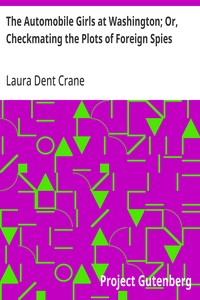
The Automobile Girls at Washington; Or, Checkmating the Plots of Foreign Spies — Themes and Context
6
1
Project Gutenberg
2004
Adventure and adventurers -- Juvenile fiction; Girls -- Societies and clubs -- Juvenile fiction; Automobile travel -- Juvenile fiction; Washington (D.C.) -- Juvenile fiction; Spies -- Juvenile fiction
Readers of public-domain and historical texts
Project Gutenberg digital edition
en
Edition facts
Words: 55,082
Reading time: 240 min
Text sections: 5
Source:
Project Gutenberg record #12559
In this early 20th-century girls' adventure serial, Barbara Thurston and her friends navigate Washington society while entangled with a Russian legation attaché and a Chinese embassy official, though the promised spy plot remains largely offstage in the excerpts.
Editorial Edition Score
4.7/5
★★★★★
★★★★★
Calculated from edition completeness, EPUB availability, text structure and catalogue metadata. Not a user rating.
Edition quality
The opening chapter of Laura Dent Crane's 1913 serial introduces Barbara Thurston standing at a window on Connecticut Avenue, a detail that immediately grounds the story in a specific Washington setting. The narrative voice is brisk and observant, noting the 'large old-fashioned house' and the 'twilight' that still shrouds the room. When a young man appears from a study, whistling 'Kathleen Mavourneen,' the scene establishes a tone of polite but wary social encounter. The stranger identifies himself as an attaché of the Russian legation, yet his familiarity unsettles Barbara, who has never seen him before. This moment captures the book's central tension: the collision of ordinary social life with the hinted world of international intrigue.
Social Codes and Suspicion
The excerpts reveal a world governed by strict social expectations, where a young woman's reputation is a constant concern. Barbara's instinctive wariness of the Russian attaché—'his manner was surprisingly familiar'—reflects the era's emphasis on propriety. Later, Harriet Hamlin's secret meeting with Charlie Meyers is framed as 'very indiscreet,' and she feels 'ashamed of herself.' The narrator explicitly judges Harriet's behavior as the result of being 'spoiled by too much admiration' and lacking a mother's influence. These moralizing asides are typical of the period's juvenile fiction, but they also serve to heighten the stakes: even a hint of impropriety could damage a girl's standing. The tension between social performance and genuine feeling runs through these scenes, as characters navigate invitations, receptions, and the constant scrutiny of others.
Character Through Contrast
The excerpts build character largely through contrast and direct commentary. Barbara is presented as sensible and cautious, while Harriet is impulsive and self-centered. Charlie Meyers is described in blunt terms: 'ill-bred,' uneducated, and possessed of 'an immense fortune' he did nothing to earn. The narrator's voice is often judgmental, as when it notes that Meyers 'thought himself of tremendous importance without making any effort to prove himself so.' This technique gives the reader clear moral signals, but it also flattens characters into types. The Russian attaché, by contrast, remains enigmatic—charming but potentially dangerous. The story's reliance on such contrasts suggests a world where virtue and vice are easily distinguished, even if the plot complicates these categories.
The Elusive Spy Plot
Despite the title's promise of 'foreign spies,' the excerpts show little direct espionage. The Russian attaché's appearance hints at intrigue, but his conversation is limited to social pleasantries. The catalog subject 'Spies' is thus more a promise than a present reality in these pages. The story's energy comes from social maneuvering—Harriet's secret errand, her need for money, her manipulation of Charlie Meyers. The 'checkmating' of plots may occur later, but the excerpts focus on the domestic and romantic tensions that precede any overt spycraft. This gap between catalog subject and textual evidence is instructive: readers expecting a thriller may find instead a social drama with occasional hints of international danger. The book's serial nature likely means the spy plot develops gradually, with the Washington setting providing a backdrop of diplomatic intrigue that remains largely atmospheric in the early chapters.
Readers approaching this book should adjust expectations: the spy plot is a framing device rather than the immediate focus. The real interest lies in the social dynamics among the girls and their Washington acquaintances. Pay attention to how Crane uses setting—the Hamlin house, Connecticut Avenue, the drive toward Arlington—to create a sense of place that anchors the characters' moral dilemmas. The excerpts suggest a story more concerned with reputation and resourcefulness than with international conspiracy, at least in its opening chapters.
Reader reflection
What did you think of this book?
Answer a few questions and save a private reflection on this device.
Your progress
0
/
10
2
How much did you enjoy the reading experience?
3
Is this a title you would suggest to others?
4
How much effort did this book require?
5
Did you relate to its people, ideas, or situations?
6
Did you gain anything practical from the text?
7
Was the book moving at the right speed?
8
Could you see yourself revisiting this book?
9
In one sentence, what did you learn?
10