1

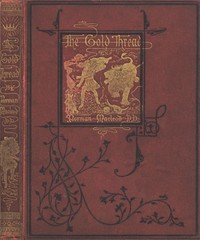
The Gold Thread: A Story for the Young — Key Ideas to Explore
7
1
Project Gutenberg
2008
Conduct of life -- Juvenile fiction; Children's stories
Readers of public-domain and historical texts
Project Gutenberg digital edition
en
Edition facts
Words: 16,156
Reading time: 71 min
Text sections: 2
Source:
Project Gutenberg record #26039
Norman MacLeod's 1867 allegory follows Prince Eric, who must hold fast a gold thread representing trust in God while navigating a forest of temptations, rescuing the swineherd Wolf from a bloodhound and a robber's tower.
Editorial Edition Score
4.5/5
★★★★★
★★★★★
Calculated from edition completeness, EPUB availability, text structure and catalogue metadata. Not a user rating.
Edition quality
Norman MacLeod opens The Gold Thread with a direct address to his own children, explaining that the story was first written and read aloud among the green hills of Moffat. The gold thread itself is introduced not as a magical object but as a metaphor for doing what is right and trusting God, a lesson MacLeod ties explicitly to biblical figures such as Noah, Abraham, and Daniel. The narrative voice is that of a father-teacher, shaping every episode around a moral choice.
Diction and the Father's Voice
MacLeod’s diction is deliberately plain and instructional, suited for a child listener. In the dedication, he writes that the story was “for you I first wrote it, and to you I first read it,” establishing an intimate, oral tone. The narrator frequently breaks into direct commentary: “Now, what shewed that they were good? It was this, that they trusted God, and did what was right.” Such rhetorical questions and answers mimic a parent’s teaching style. The vocabulary is concrete—words like “nursery,” “play-ground,” “selfish,” “disobedient”—grounding abstract virtue in everyday childhood experience. MacLeod avoids ornate description; even the forest is a “rolling sea of leaves,” a single vivid image rather than a prolonged landscape.
Dialogue as Moral Barometer
Dialogue in the excerpts reveals character through obedience or defiance of the thread’s pull. When Eric hears a cry for help, he is “almost tempted to run off … without his thread,” but the thread itself leads him to the drowning boy. His words are measured: “I must do my work now, and play like you afterwards.” Wolf, by contrast, speaks in exclamations and proverbs: “O rub-a-dub, dub!” and “Ralph would have killed me like a pig.” His speech is rougher, marked by fear and superstition—he hears a “voice” telling him to run. The bloodhound’s approach is rendered through onomatopoeic repetition (“Bow-wow-wow-o-o-o”), a sound that escalates tension without needing elaborate description. Each character’s language matches their moral station: Eric’s calm resolve versus Wolf’s impulsive panic.
Structure and the Unbroken Thread
The story’s structure is a linear quest held together by the gold thread, which physically tugs Eric forward. MacLeod uses the thread as both plot device and organizing principle: every scene begins with Eric feeling the thread tighten or following its direction. When he rescues Wolf, the thread “supported them both above the water,” merging physical and moral buoyancy. The thread also prevents digression—Eric cannot hide up a tree because he “must hold fast my thread.” This structural constraint mirrors the moral lesson: obedience to the thread is the only path forward. Chapter titles like “The Wanderer—Wolf the Swineherd” and “The Robber’s Tower” promise episodic adventures, but each episode is a test of fidelity to the thread.
Recurring Details: The Forest and the Voice
The forest is the story’s constant setting, described as “a vast forest that filled many a valley, and passed over many a hill.” It is a place of lostness and danger, where Eric must keep hold of the thread to find his way. Within this forest, recurring details build a sensory world: the sound of the bloodhound’s bark echoing, the “deep, dark pool” where Wolf nearly drowns, and the “steep hill” the boys scramble up. Wolf’s reference to a “voice” that told him to run after Eric hints at an unseen guidance parallel to the thread. These details are not merely atmospheric; they are the tangible obstacles through which the thread’s reliability is demonstrated. The forest is never named or mapped—it is a universal wilderness of temptation.
Readers attentive to MacLeod’s authorial choices will notice how the gold thread functions less as a fantasy object and more as a narrative device that enforces a strict moral logic. The fatherly tone, the plain diction, and the episodic structure all serve to make the allegory transparent. The story rewards those who watch how each character’s speech and action either honors or strains against the thread, and how the forest itself becomes a stage for those tests.
Reader reflection
How will you remember this book?
Save your reaction, strongest insight, and memorable passage.
Your progress
0
/
10
2
Did this book hold your interest?
3
Would you pass this book on to a friend?
4
What was the reading difficulty like?
5
Did the story or argument move comfortably?
6
How understandable was the text?
7
How well did it match your expectations?
8
Did this book create an emotional response?
9
What is the main idea you are taking away?
10