1

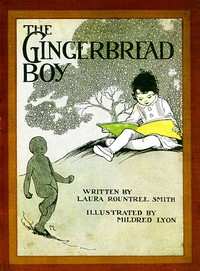
The Gingerbread Boy and Joyful Jingle Play Stories — Themes and Context
15
4
Project Gutenberg
2020
Animals -- Juvenile fiction; Children's stories
Readers of public-domain and historical texts
Project Gutenberg digital edition
en
Edition facts
Words: 14,870
Reading time: 65 min
Text sections: 15
Source:
Project Gutenberg record #63463
This 1923 collection by Laura Rountree Smith combines the title story with eleven others, including 'Old Mother Bear's Happy New Year' and 'Little Tommy Tittlemouse.' The excerpts show moral lessons delivered through talking animals, fairies, and jingles, with repeated emphasis on punctuality, politeness, and tidiness.
Editorial Edition Score
4.7/5
★★★★★
★★★★★
Calculated from edition completeness, EPUB availability, text structure and catalogue metadata. Not a user rating.
Edition quality
The catalog subjects 'Animals -- Juvenile fiction' and 'Children's stories' accurately describe this collection, but the excerpts reveal a stronger emphasis on didactic correction than on adventure. In 'Old Mother Bear's Happy New Year,' four bear cubs are whisked away by Fairy See-It-All to a wee house in the woods, where each must practice a specific virtue for a full year: Boxer learns to be on time, Drowsy-Head to go to bed willingly, Bruin to pick up belongings, and Bright Eyes to say 'Thank you' and 'If you please.' The story then reports that after some children read it 99 times, real children began to mimic the cubs' improvements. This direct link between fictional behavior and reader conduct is a recurring structural feature.
Fairy Enforcers and Rhymed Corrections
The excerpts show that fairies in this book function less as whimsical helpers and more as disciplinary agents. In 'Old Mother Bear's Happy New Year,' Fairy See-It-All arrives 'bouncing into the room' and immediately identifies faults, then confines each cub for a year. Her commands are delivered in couplets: 'You can’t get out however you climb, / Unless you learn to be on time.' Similarly, in 'Little Tommy Tittlemouse,' a 'Funny Fairy' and a 'Number Fairy' appear to address Tommy’s difficulty with multiplication. The fairies do not offer gentle encouragement; they state consequences and prescribe practice. This pattern suggests that the collection consistently uses supernatural figures to enforce behavioral norms, with jingles serving as memorable rules.
Repetition as a Narrative and Pedagogical Tool
The text employs repetition at multiple levels. Within 'Old Mother Bear's Happy New Year,' the phrase 'away, away, away' appears three times, and the cubs’ refrain 'We want Mother Bear, we want to go home' is repeated. More strikingly, the story explicitly states that after children read it '99 times,' real-world changes occurred—a boy arrived on time, a girl went to bed happily, a boy picked up his toys. This meta-narrative claim turns the story into a quasi-instructional device, implying that repeated reading itself produces moral improvement. The preface reinforces this by noting that the stories 'have good influence upon the little readers' and that 'catchy little jingles run throughout.' The combination of narrative repetition and jingle repetition suggests a deliberate design to aid memorization and habit formation.
Limited Evidence of the Title Story
Despite the book’s title, the excerpts contain no text from 'The Gingerbread Boy' itself—only the table of contents and the preface mention it. The preface states that the first three stories (presumably including the title story) 'found great favor with the reading public, having been published in the Woman’s Home Companion,' but no excerpt confirms the plot, characters, or tone of that story. The catalog subject 'Animals -- Juvenile fiction' may apply to the title story, but the available excerpts focus entirely on bears, a mouse, and fairies. Readers approaching the book for a gingerbread-themed tale should be aware that the collection includes eleven other stories, and the title story may not be representative of the whole. The excerpts suggest that moral lessons delivered by fairies and talking animals are the dominant mode.
The excerpts from this 1923 collection reveal a consistent pattern: fairies identify flaws, prescribe rhymed corrections, and enforce practice until behavior improves. The preface and the story 'Old Mother Bear’s Happy New Year' explicitly frame the book as a tool for shaping children’s habits. Readers interested in early twentieth-century didactic children’s literature will find this a clear example of the genre, though the title story remains unexamined in the available text.
Reader reflection
What did you think of this book?
Answer a few questions and save a private reflection on this device.
Your progress
0
/
10
2
Did this book hold your interest?
3
Is this a title you would suggest to others?
4
How much effort did this book require?
5
Did you gain anything practical from the text?
6
Did any part of the book stay with you emotionally?
7
How original did the book feel?
8
Did the book meet your expectations?
9
What changed or sharpened your thinking?
10