1

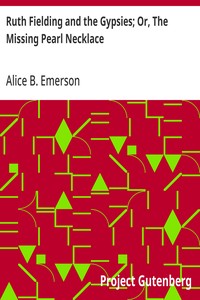
Ruth Fielding and the Gypsies; Or, The Missing Pearl Necklace — Background and Themes
6
1
Project Gutenberg
2007
Adventure and adventurers -- Juvenile fiction; Rescues -- Juvenile fiction; Fielding, Ruth (Fictitious character) -- Juvenile fiction; Hostages -- Juvenile fiction; Romanies -- Juvenile fiction
Readers of public-domain and historical texts
Project Gutenberg digital edition
en
Edition facts
Words: 47,880
Reading time: 209 min
Text sections: 7
Source:
Project Gutenberg record #22743
This editorial note examines Alice B. Emerson's diction and dialogue in the 1915 children's adventure, focusing on how the author uses sensory description, dialect, and physical transformation to portray Ruth's captivity among the Gypsies.
Editorial Edition Score
4.7/5
★★★★★
★★★★★
Calculated from edition completeness, EPUB availability, text structure and catalogue metadata. Not a user rating.
Edition quality
From the opening sentence, Alice B. Emerson grounds the reader in the physical world of the Red Mill: 'The steady turning of the grinding-stones set the old Red Mill a-quiver in every board and beam.' The mill is not merely a setting but a character in its own right, its dust and vibration establishing a tactile, sensory atmosphere. Emerson’s prose leans heavily on concrete nouns and active verbs—'croaked,' 'hobble,' 'plunged'—to keep the narrative moving at a brisk pace. Dialogue is used to reveal character quickly: Mercy Curtis’s cheerful greeting, 'Hello, Dusty Miller!' and her reference to her canes as 'aeroplanes' signal her pluckiness without lengthy exposition. These authorial choices create a world where objects and actions carry emotional weight, and where every line of dialogue advances both plot and personality.
Sensory Immersion and the Mill as a Living Space
Emerson’s description of the Red Mill is remarkably tactile. The mill is 'a-quiver in every board and beam,' and the air is 'full of dust—dust of the grain, and fine, fine dust from the stones themselves.' This repetition of 'dust' emphasizes the pervasive, almost oppressive atmosphere. The miller, Uncle Jabez, is introduced through his voice—'croaked'—and his dialect: 'How do you reckon a man like me kin fly, Mercy child?' The author uses dialect sparingly but effectively to distinguish characters. Mercy’s canes, hidden in the grass, are revealed as 'ebony canes,' a small but precise detail that underscores her disability and her resilience. The setting is not merely backdrop; it is a sensory experience that shapes the characters’ interactions and moods.
Dialogue as a Tool for Character and Tension
Emerson’s dialogue is functional and revealing. When Ruth shouts to Helen, 'Keep on! keep on! Never mind me! Find Tom and bring help—— Oh!' the urgency is conveyed through short, imperative sentences and the abrupt interruption of 'Oh!' as she is dragged down. The Gypsy woman’s laugh—'as though it were a great joke'—contrasts sharply with the men’s violence, highlighting a range of responses within the group. Queen Zelaya’s commands are clipped and authoritative: 'Quick, now! Take off your hat. Gypsies have no use for hats.' The dialogue rarely meanders; every exchange either advances the plot or deepens character. Even minor characters, like the squint-eyed man, are defined by their actions and sparse words, creating a vivid ensemble.
Physical Transformation as a Narrative Device
Ruth’s forced transformation into a Gypsy is described with clinical precision. Zelaya anoints Ruth’s face and neck with a lotion, then 'threw some earth on Ruth’s feet and streaked her limbs with the same.' The detail of 'earth' rather than generic dirt grounds the scene in the physical. Ruth is given a 'torn and not over-clean frock,' and her hair is darkened with lotion. The transformation is not just cosmetic but psychological: Zelaya hisses, 'We say you are ours—a wicked, orphan Gypsy, wicked through and through.' The author uses this disguise plot to explore identity and power, but never loses sight of the concrete details—the hat thrust into a box, the shoes removed. These small, specific actions make the captivity feel immediate and real.
Voice and Perspective in the Captivity Sequence
Throughout the captivity chapters, Emerson maintains a tight third-person perspective focused on Ruth. The reader experiences the confusion and fear through her senses: the 'long-drawn, eerie cry' that signals a change in the Gypsies’ plans, the 'claw-like hand' of Zelaya, the 'ugly garment' she is forced to wear. The author avoids interior monologue, instead relying on action and dialogue to convey emotion. When Ruth screams, 'Use your pole!' the imperative is both practical and desperate. The narrative never strays into Ruth’s thoughts for long, keeping the pace swift and the tension high. This external focus aligns with the adventure genre’s emphasis on action over introspection, but Emerson’s precise physical details—the 'strong' skirt material, the 'considerable current' in Long Lake—prevent the action from feeling generic.
Readers approaching Ruth Fielding and the Gypsies will find a narrative that prioritizes sensory detail and brisk dialogue over psychological depth. Emerson’s authorial choices—the tactile mill, the functional speech, the methodical disguise—create a world that feels both immediate and formulaic in the best tradition of early twentieth-century series fiction. Pay attention to how objects and actions carry meaning: a pair of ebony canes, a torn frock, a handful of earth. These small details are the building blocks of Emerson’s storytelling, and they reward close reading.
Reader reflection
How will you remember this book?
Save your reaction, strongest insight, and memorable passage.
Your progress
0
/
10
2
How much did you enjoy the reading experience?
3
Would you recommend this book to another reader?
4
How much effort did this book require?
5
What was its emotional impact?
6
Would a second reading be valuable?
7
Did the book offer a fresh perspective?
8
Would this book work well in a reading group?
9
What did this book teach you most?
10