1

Popular Tales — Edition Insights
8
0
Project Gutenberg
2013
Conduct of life -- Juvenile fiction; Children's stories; Children -- Conduct of life -- Juvenile fiction
Readers of public-domain and historical texts
Project Gutenberg digital edition
en
Edition facts
Words: 122,564
Reading time: 533 min
Text sections: 11
Source:
Project Gutenberg record #42839
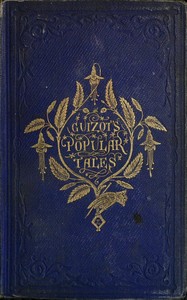
Madame Guizot's 1854 collection of eleven moral tales, translated by Mrs. L. Burke, uses recurring images of clocks, animals, and contested authority to explore children's conduct and the consequences of disobedience.
Editorial Edition Score
4.9/5
★★★★★
★★★★★
Calculated from edition completeness, EPUB availability, text structure and catalogue metadata. Not a user rating.
Edition quality
From the first tale, 'Scaramouche,' Madame Guizot establishes a world where animals and objects become instruments of moral instruction. The learned ass Martin and the parrot Jacquot perform for a village fair, their tricks mirroring the obedience expected of children. The translator Mrs. L. Burke preserves the French setting while rendering the dialogue in a natural English idiom, capturing the sharp exchanges between characters.
The collection's structure alternates between longer narratives like 'Scaramouche' and shorter pieces such as 'The Double Vow.' Across the tales, recurring motifs—clocks that disagree, disputed household rules, and absent parents—create a consistent framework for exploring how children navigate authority and temptation.
Clocks and Contested Time
In 'Scaramouche,' the fairground entertainers operate on their own schedules, but the tale's central conflict emerges when a timepiece becomes a symbol of control. Louis, left with his aunt during his mother's absence, finds the house clock deliberately altered to assert authority. The narrator notes that Louis 'had set them together in the morning' only to find the time-piece advanced without his knowledge. This small act of manipulation triggers a chain of disobedience and resentment.
Throughout the collection, clocks and watches appear as markers of reliability and trust. In 'The Difficult Duty,' characters debate punctuality as a moral obligation. The repeated image of mismatched timepieces suggests that children must learn to navigate conflicting expectations from adults who themselves bend rules. Guizot does not present time as abstract but as a tangible site of power struggles, where being 'punctual' becomes a test of character.
Animal Performers and Human Lessons
The opening scene of 'Scaramouche' introduces Martin the learned ass and Peerless Jacquot the parrot, animals trained to respond to commands for an audience. Their performances—Martin telling the hour, Jacquot replying to questions—parallel the behavior expected of children in the tales that follow. Yet the animals are also objects of commerce; their owner Matthieu la Bouteille profits from their tricks, just as adults in later stories leverage children's obedience for social approval.
Guizot uses these animal acts to question the line between genuine understanding and rote compliance. When the parrot 'replies to what you do not say to him,' the joke hints at the gap between outward conformity and inner conviction. Later tales, such as 'Poor José,' extend this motif by depicting children who must perform roles assigned by adults, their true feelings hidden behind trained responses.
The Architecture of Absence
Several tales hinge on a parent's departure, leaving children to manage their own conduct. In 'Scaramouche,' Madame Delong's sudden journey to attend her wounded husband creates a vacuum of authority. The narrator emphasizes that Louis is left 'to his own discretion' with an aunt 'incapable of maintaining any authority.' This structural pattern recurs in 'The Mother and Daughter' and 'Caroline; or, The Effects of a Misfortune,' where absence forces young protagonists to confront moral choices without direct supervision.
Guizot's treatment of absence is notably unsentimental. Rather than romanticizing the child's independence, she shows how quickly order dissolves when the guiding figure vanishes. The household disputes over soup tureens and glass-rinsing rituals in 'Scaramouche' escalate into full rebellion, suggesting that external rules, not inner virtue, often govern behavior. The tales thus examine what happens when the scaffolding of adult presence is removed.
Dialogue as Moral Arena
Guizot's narratives rely heavily on direct speech, with characters arguing, pleading, and justifying themselves in extended exchanges. In the excerpt from 'Scaramouche,' the children Amadeus, Juliana, and Paul debate obedience with the Curé, each citing their own compliance while exposing others' faults. Juliana threatens to reveal Amadeus's 'naughty words,' while Paul boasts of avoiding water when his mother is away. These dialogues do not simply convey plot but serve as arenas where moral positions are tested.
The Curé's role as listener and occasional storyteller mirrors the reader's position: he prompts reflection without dictating conclusions. Guizot's preference for showing rather than telling is evident in the way children's words reveal their character. The sharp retorts and tactical accusations feel authentic to childhood squabbles, yet each exchange advances the tale's ethical inquiry. This technique gives the collection a dramatic immediacy that distinguishes it from more didactic children's literature of the period.
Readers approaching Popular Tales will find that the stories reward attention to small details—the placement of a soup tureen, the setting of a clock, the gesture of a trained animal. Guizot builds her moral lessons not through abstract precepts but through concrete, often domestic, situations that children would recognize. The translation by Mrs. L. Burke preserves the conversational tone and period flavor, making this edition a valuable window into nineteenth-century French children's literature and its methods of shaping young readers.
Reader reflection
How will you remember this book?
Save your reaction, strongest insight, and memorable passage.
Your progress
0
/
10
2
How much did you enjoy the reading experience?
3
Would you pass this book on to a friend?
4
How much effort did this book require?
5
How well did it match your expectations?
6
What did you think about the pace?
7
Was the book easy to understand?
8
Would you like to discuss this book with someone?
9
What is the main idea you are taking away?
10