1

Pleasing Stories for Good Children with Pictures — Reading Companion
7
1
Project Gutenberg
2008
Conduct of life -- Juvenile fiction; Children's stories; Children -- Conduct of life -- Juvenile fiction; Picture books for children
Readers of public-domain and historical texts
Project Gutenberg digital edition
en
Edition facts
Words: 4,626
Reading time: 21 min
Text sections: 1
Source:
Project Gutenberg record #24738
This 19th-century children's book uses short moral tales and direct address to teach obedience, charity, and caution. Each story pairs a vivid incident—like a girl falling from a fence—with an explicit lesson, reinforced by hymns and rhetorical questions.
Editorial Edition Score
4.4/5
★★★★★
★★★★★
Calculated from edition completeness, EPUB availability, text structure and catalogue metadata. Not a user rating.
Edition quality
Each story in Pleasing Stories for Good Children follows a tight pattern: a child commits a small error or performs a kind act, a consequence or reward is shown, and a narrator steps in to explain the moral. In “Little Jane and the Poor Man,” the girls give pennies to a lame man, and the text immediately inserts a hymn about gratitude. In “The Rude Girl,” Jane climbs a locked gate and falls headfirst; the narrator warns that bruises are soon forgotten. This structure—incident, then commentary—turns every page into a miniature sermon.
The book’s movement between scenes is abrupt. One story ends, the next begins with a new name and a fresh misdeed. There is no overarching plot, only a series of cautionary tableaux designed to imprint correct behavior through repetition.
The Narrator’s Direct Address
The narrator speaks to the child reader as “you” and “your little sisters,” creating an intimate, instructional tone. In “Little Jane,” the question “Did you ever learn the little hymn, which speaks about the poor?” turns the story into a springboard for memorization. The narrator also uses collective “we”: “We were glad to see them so willing to part with their pennies.” This voice assumes authority over the child’s conscience, praising good deeds and scolding bad ones. The effect is that of a parent or teacher reading over the child’s shoulder, ensuring the lesson is absorbed.
Recurring Images of Falling and Bruising
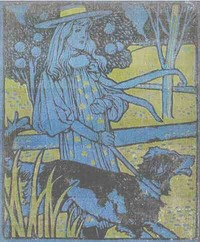
Physical harm is a repeated image. In “The Rude Girl,” Jane falls “head foremost” and the narrator warns of a broken neck. The text says “the falls and bruises of their companions seem not to warn them.” This image recurs: children ignore past accidents and suffer again. The body becomes a site of moral instruction—bruises are proof of folly. The book uses these vivid, painful pictures to make disobedience tangible. The accompanying illustrations (mentioned in the text) would have reinforced the shock of a child tumbling from a fence.
The Hymn as Embedded Lesson
In “Little Jane,” the narrator inserts a complete hymn about poverty and gratitude. The hymn’s lines—“I have food, while others starve”—echo the story’s charity theme. This is not a casual addition; the hymn is meant to be learned “by heart.” The book thus blends narrative and catechism. The hymn’s first-person voice (“I am taught thy name to fear”) contrasts with the third-person story, shifting from example to personal prayer. This technique turns reading into a devotional exercise, linking everyday kindness to religious duty.
Movement Between Scenes and Moral Certainty
The book jumps from one child to another with no transition. “Little Jane” ends with a hymn; “The Rude Girl” begins with a blunt statement: “Jane Jones was a very rude girl.” This abruptness mirrors the binary moral world: children are either kind or rude, obedient or foolish. There is no ambiguity. The setting is minimal—a street, a gate, a home—enough to stage the lesson. The speed of the scenes suggests that misbehavior is everywhere and must be corrected instantly. Each story is a self-contained warning, and the reader is expected to apply it immediately.
Readers should approach this book as a period artifact of moral instruction rather than a narrative collection. The stories are short enough to read aloud in a single sitting, and the hymns invite repetition. Pay attention to how the narrator’s voice shifts from storytelling to sermonizing—that shift is the book’s core mechanism. The illustrations, though not reproduced here, would have been essential to the impact of scenes like Jane’s fall.
Reader reflection
How did this book work for you?
Your answers remain private and are stored only in this browser.
Your progress
0
/
10
2
Did this book hold your interest?
3
Would you encourage someone else to read it?
4
How much effort did this book require?
5
Could you follow the author’s main argument?
6
How closely did the book connect with your experience?
7
How useful were the ideas in this book?
8
Do you expect to return to this book?
9
What did this book teach you most?
10