1

More Stories of the Three Pigs — Reading Companion
6
1
Project Gutenberg
2015
Children's stories; Swine -- Juvenile fiction
Readers of public-domain and historical texts
Project Gutenberg digital edition
en
Edition facts
Words: 11,967
Reading time: 53 min
Text sections: 2
Source:
Project Gutenberg record #49141
This editorial note examines how Sarah Grames Clark expands the classic Three Little Pigs tale through new characters, domestic dialogue, and a moral framework where Bad Boy Mischief personifies disobedience, based on excerpts from the 1921 children's book.
Editorial Edition Score
4.5/5
★★★★★
★★★★★
Calculated from edition completeness, EPUB availability, text structure and catalogue metadata. Not a user rating.
Edition quality
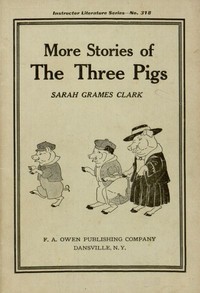
Sarah Grames Clark’s More Stories of the Three Pigs (1921) does not retell the familiar fable so much as extend it into a small domestic universe. The surviving pig, Grunty, now a mother, names her piglets Blacky-ears and Little-wee Pig—the first distinguished by “two black ears,” the second by a “curly tail and a squeaky voice.” Clark introduces a personified figure, Bad Boy Mischief, who “hopped right onto Blacky’s shoulder and whispered in his ear,” turning a simple command into a test of character. The narrative voice addresses the reader directly (“You have all heard of the three little pigs”), blending folk-tale intimacy with a schoolroom moral tone.
A New Cast and a Moral Adversary
Clark populates her sequel with original characters while retaining the wolf as a distant threat. Grunty’s sons are defined by contrasting traits: Blacky-ears is sullen and easily swayed by Bad Boy Mischief, while Little-wee Pig is cheerful and obedient. The wolf, though never appearing onstage in the excerpts, is invoked through Grunty’s past—she recalls his “wicked grin” and the “heavy feet scratched and clawed on the thin wood.” Clark uses the wolf as a memory rather than a present danger, shifting tension from physical peril to moral choice. Bad Boy Mischief functions as a transparent allegory for disobedience, whispering “just as Bad Boy Mischief had told him to” when Blacky-ears grumbles. This device makes the story’s lesson explicit without requiring a villain’s intervention.
Domestic Dialogue and Storytelling Within the Story
The excerpts reveal a strong emphasis on conversation as a narrative engine. Grunty tells her own backstory to Miss Pinky Pig, recounting the wolf’s pursuit and her escape in a churn. Blacky-ears interrupts with “You bet she did,” and Little-wee Pig urges, “Tell her about the time Blacky-ears was lost, Mumsie.” This layered storytelling—a tale within a tale—allows Clark to revisit the original plot while showcasing the piglets’ distinct voices. The dialogue is colloquial and childlike: “Aw, wait a minute, can’t you?” grumbles Blacky-ears. Clark also uses the frame of a visit: Miss Pinky Pig intends to “talk school” but stays for supper, and Grunty ends by saying, “Won’t you come back again next Thursday?” The social rhythm of calls and returns structures the narrative as much as any plot event.
Diction and the Personification of Mischief
Clark’s diction blends folksy directness with mild didacticism. She writes that “Bad Boy Mischief, you remember, is always after everyone; little children, little bears, and little pigs.” The capitalized name and the inclusive “everyone” universalize the concept. The phrase “Bad Boy Mischief heard Mother Grunty call, he hopped right onto Blacky’s shoulder” treats mischief as a tangible sprite, not an abstract flaw. Elsewhere, Grunty’s speech retains a colloquial edge: “I shook with fear and could scarcely keep from crying out.” Clark avoids archaic fairy-tale formality in favor of a conversational tone that suits the “Instructor Literature Series” label. The illustrations by Bess Bruce Cleaveland, though not described in the excerpts, likely reinforced this accessible, moralized world.
Structure and the Series Context
The book’s table of contents lists six stories: “A Trip to Styford,” “Mother Porky Goes Visiting,” “Christmas in Pigland,” “The Piglets Go Picnicking,” “Miss Pinky Pig Visits,” and “Mother Grunty.” The excerpts come from the first and fifth stories, suggesting a episodic structure rather than a single arc. Each title promises a domestic or social event, not a survival plot. The book is part of the “Instructor Literature Series,” a line of inexpensive supplementary readers for grades one through three, as shown in the back-matter catalog. That catalog lists titles like “Three Billy Goats Gruff and Other Stories” and “Story of Peter Rabbit,” placing Clark’s work in a pedagogical tradition where familiar animal characters teach behavior and reading skills. The word count (11,967) and estimated 53-minute reading time align with a short chapter book for early readers.
Readers approaching More Stories of the Three Pigs should expect a series of vignettes rather than a continuous plot. Clark’s language rewards attention to how she personifies temptation and how her characters speak. The excerpts do not reveal whether the wolf ever reappears or how the piglets’ moral struggles resolve. The book’s value lies in its expansion of a single survivor into a family, and in its quiet demonstration of how a traditional tale can be repurposed for early literacy instruction without losing its narrative charm.
Reader reflection
Your personal reading reflection
Build a private reading journal entry for this title.
Your progress
0
/
10
2
Was reading this book enjoyable?
3
Would you pass this book on to a friend?
4
How much effort did this book require?
5
Would you like to discuss this book with someone?
6
What did you think about the pace?
7
Did any part of the book stay with you emotionally?
8
Which part made the strongest impression?
9
Which lesson or insight stayed with you?
10