1

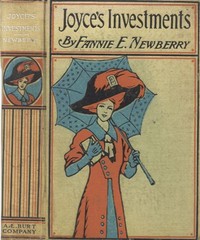
Joyce's Investments: A Story for Girls — Reading Companion
7
1
Project Gutenberg
2007
Children's stories; Girls -- Juvenile fiction
Readers of public-domain and historical texts
Project Gutenberg digital edition
en
Edition facts
Words: 79,719
Reading time: 347 min
Text sections: 8
Source:
Project Gutenberg record #21857
Fannie E. Newberry's 1899 novel follows Joyce Lavillotte, a young heiress who insists on managing a factory village herself, clashing with her lawyer. The narrative contrasts her creole-inherited idealism with the gritty realities of workers like Dan, whose secret refuge is invaded. Diction and dialogue reveal class tensions and personal resolve.
Editorial Edition Score
4.7/5
★★★★★
★★★★★
Calculated from edition completeness, EPUB availability, text structure and catalogue metadata. Not a user rating.
Edition quality
From the opening chapter, Fannie E. Newberry establishes Joyce Lavillotte as a determined young woman through her direct, impassioned speech. When her lawyer calls her plan a 'crazy scheme,' she counters with a 'liquid voice which was an inheritance from her creole ancestry,' insisting she knows her own mind. The lawyer's 'grunt and laugh' and his description of her as 'flushed and bright-eyed' set up a generational and gendered clash over authority and money.
Newberry's diction in the dialogue is precise: Joyce uses words like 'province' to delineate responsibilities, while the lawyer speaks of 'bonds and mortgages' as safe investments. This early exchange signals that the novel will explore not just a plot about managing a factory, but the very language of control and independence.
Voices of Authority and Resistance
The dialogue in the excerpts is sharply individuated. Joyce's speech is fluid and emotional, marked by phrases like 'I do not mean to risk my last dollar' and 'I don't want to be kept like a princess.' The lawyer, Mr. Barrington, uses legal and financial jargon—'sell out,' 'safely invested'—and his physical description as 'inscrutable of aspect' mirrors his verbal caution. Newberry contrasts these with the interior monologue of Dan, a worker, whose thoughts are bitter and colloquial: 'Always caught with something new!' he mutters, and 'It makes me tired!' His voice is cynical, weary, and grounded in physical sensation—'he was weary'—while Joyce's is aspirational and defiant.
Even minor characters are given distinct vocal traits. Mrs. Hemphill 'screaming her commands' from indoors, and Rachel's sharp retort, 'Well, what is it?' show domestic tension through brief, telling lines. Newberry uses dialogue not just to advance plot but to reveal social position and inner conflict.
The Weight of Setting and Description
Newberry's descriptive passages do more than set scenes; they carry emotional and thematic weight. Dan's secret bower is described with careful sensory detail: 'vine tangles and underbrush,' 'traces of a camp-fire,' 'scattered leaves from his bed.' The intrusion of a stranger is felt as a violation—'a chill crept over him'—and the landscape itself seems to react: 'something that was not a shadow seemed to move.' The brook is 'waded,' and the 'spray of the up-leaping water' sparkles, linking nature to Dan's heightened alertness.
In contrast, the lawyer's office is rendered through metaphor: his eyebrows are 'as from the port-holes of a castle,' making him seem fortified and distant. The factory village is evoked indirectly, through references to 'the well-lighted building' and 'the younger tide of humanity' setting toward it. Setting in this novel is never neutral; it reflects characters' inner states and the social structures they navigate.
Recurring Motifs: Inheritance and Investment
The title's 'investments' operates on multiple levels. Joyce speaks of her mother's money as 'enough for my few needs' and refuses to use her father's inheritance for herself, insisting instead on investing in the Works and the village. The lawyer counters with 'bonds and mortgages' as safer investments. This financial language recurs in Dan's thoughts: he recalls 'fair promises year after year—promises that were as empty as a glass bulb.' The metaphor of empty promises as hollow objects echoes the theme of investment—both monetary and emotional.
Newberry also uses the motif of inheritance beyond money. Joyce's 'creole ancestry' gives her a 'liquid voice' and a certain temperament; Dan's 'dark face' and his past—'experience had sternly taught him' that there are 'things in life worse than physical hardships'—suggest a different kind of inheritance, one of hardship and suspicion. The novel seems to ask what one inherits and what one chooses to invest.
Narrative Structure and Point of View
The excerpts show Newberry shifting between third-person limited perspectives. The opening chapter stays close to Joyce, rendering her thoughts and feelings directly: 'She, flushed and bright-eyed, leaned forward with an appealing air.' Later, the narrative moves into Dan's consciousness, using free indirect discourse to convey his cynicism and weariness: 'He would scarcely fling a glance in the direction of the well-lighted building.' The transition is seamless, and the reader is given access to characters who occupy very different social positions.
This structural choice allows Newberry to contrast Joyce's hopeful idealism with Dan's hardened realism without authorial commentary. The lawyer's perspective is rendered externally, through his gestures and grunts, keeping him somewhat opaque. By alternating focalization, the novel builds a layered picture of the factory community, where no single viewpoint dominates.
Readers attentive to Newberry's craft will notice how she uses small verbal and physical details—a 'grunt,' a 'sigh of relief,' a 'sharp' reply—to build character and tension. The excerpts suggest a novel that rewards close reading of dialogue and description, where the texture of language itself carries the story's social and emotional weight. Pay attention to who speaks, how they speak, and what they see; these choices reveal the investments that truly matter.
Reader reflection
How did this book work for you?
Your answers remain private and are stored only in this browser.
Your progress
0
/
10
2
How much did you enjoy the reading experience?
3
Would you pass this book on to a friend?
4
What was the reading difficulty like?
5
What did you think about the pace?
6
How personally connected did you feel to the book?
7
Did you gain anything practical from the text?
8
Did the book offer a fresh perspective?
9
Which lesson or insight stayed with you?
10