1

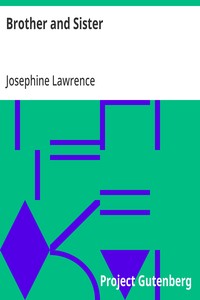
Brother and Sister — Reading Notes
19
3
Project Gutenberg
2003
Children's stories; Family -- Juvenile fiction
Readers of public-domain and historical texts
Project Gutenberg digital edition
en
Edition facts
Words: 27,107
Reading time: 118 min
Text sections: 4
Source:
Project Gutenberg record #4784
An editorial note examining Josephine Lawrence's use of dialogue, domestic detail, and sibling dynamics in 'Brother and Sister,' focusing on how the author's word choices and descriptive habits shape the story's tone and character relationships.
Editorial Edition Score
4.5/5
★★★★★
★★★★★
Calculated from edition completeness, EPUB availability, text structure and catalogue metadata. Not a user rating.
Edition quality
Josephine Lawrence opens 'Brother and Sister' with a breakfast-table dispute over milk, immediately establishing a household where persuasion is negotiated through playful logic and family banter. Brother argues that rain makes outdoor growth impossible, so drinking milk is unnecessary—a child's reasoning that Ralph counters with a bribe tied to birthday presents. This early exchange reveals Lawrence's ear for natural, age-appropriate dialogue and her method of embedding character traits in everyday conversation. Throughout the excerpts, she favors concrete, sensory details: the crumb-brush sweeping a table, the feel of a cooler dress after a nap, the sound of a hammer nailing barbwire. These small observations anchor the narrative in a tangible world, while the repeated emphasis on chores, gifts, and minor disappointments builds a rhythm of domestic life that feels both specific and universal.
Dialogue as a Window to Character
Lawrence rarely tells the reader what a character feels; instead, she lets speech reveal temperament. Sister's practical interjection—'Come on, and bring the bread tray'—contrasts with Brother's dreamy crumb-farming, showing their distinct approaches to responsibility. Louise's soothing tone when coaxing Sister upstairs ('You'll feel much better, honey') is undercut by her sharp earlier retort ('Don't be silly!'), hinting at the range of sibling patience. The author also uses dialogue to convey social rules: Louise's lecture about tormenting Miss Putnam carries the weight of parental expectation, while Brother's cross 'I think you're mean!' captures unfiltered childhood frustration. These exchanges are never expositional; they feel overheard, not constructed.
The Weight of Small Objects
Lawrence invests everyday items with emotional significance. The white piqué napkin ring embroidered with an 'L' is not just a detail but a marker of order and belonging. Brother's imagined tool-chest and Sister's request to borrow his saw tie gift anticipation to shared play. The Grandfather's clock on the stair landing becomes a symbol of imposed bedtime, its chime a source of resentment. Even the barbwire Miss Putnam nails to her fence is more than a plot point—it signals territorial conflict and the adult world's intrusion into children's space. By focusing on such objects, Lawrence grounds the story in a material reality that young readers can recognize, while subtly investing each item with narrative weight.
Rhythms of Routine and Disappointment
The story moves through a cycle of daily tasks—clearing the table, feeding birds, taking naps—that establish a predictable domestic rhythm. Lawrence uses this routine to frame moments of disruption. The Fourth of July picnic is a high point, but it is immediately followed by the letdown of being denied a movie outing. Brother and Sister's shared disappointment on the front stairs after their parents leave is rendered without melodrama: they simply sit, cross, while the clock ticks. This pattern of anticipation and frustration recurs throughout the excerpts, from Ralph's birthday hint to the barbwire incident. Lawrence does not exaggerate the children's emotions; she lets the small scale of their grievances speak for itself, trusting that a missed movie can feel as significant as any larger loss.
Voice and the Absence of Adult Omniscience
Lawrence limits the narrative perspective largely to the children's viewpoint, even when adults are present. Mother Morrison's commands are reported without interior commentary; Ralph's teasing is delivered through dialogue alone. The narrator occasionally steps in with a gentle gloss—'She had not been thoroughly awake, you see'—but these interventions are rare and brief. More often, the text lets actions and words carry meaning. When Sister toils upstairs 'feeling much abused,' the phrase is her own internal register, not an adult judgment. This restraint gives the prose a clean, uncluttered quality and keeps the focus on how the children experience their world, rather than on how an adult might interpret it.
Readers attentive to Lawrence's craft will notice how she builds a family portrait through small, precise strokes rather than grand declarations. The author's choices in diction—the colloquial 'dawdle,' the emphatic 'stormed' for Brother's outburst—and her preference for showing over telling make the Morrison household feel lived in. Pay attention to the way objects and routines recur; they are not decoration but the scaffolding of the children's emotional landscape. This is a story that earns its moments of feeling through accumulation, not announcement.
Reader reflection
Take a moment to reflect on this book
Create a short personal record of your experience with this book.
Your progress
0
/
10
2
How much did you enjoy the reading experience?
3
Would you encourage someone else to read it?
4
How demanding did the text feel?
5
How did the reading compare with what you expected?
6
Did this book create an emotional response?
7
Is this a title worth rereading?
8
How closely did the book connect with your experience?
9
What changed or sharpened your thinking?
10