
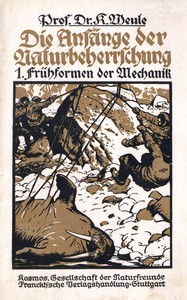
Die Anfänge der Naturbeherrschung. 1. Frühformen der Mechanik by Karl Weule
The Story
Karl Weule isn't leading you by a harness through high theory. Instead, he walks us back to start: before any labeled laws of physics existed. Ancient folks had raw problems: how to break bones while hunting, lift a dugout canoe from a river, or raise a hut over a flooding plain. Weule records solutions—manmade levers made from fallen branches, wedge-split logs for axes, and gut-drawn slings that foreshadowed modern tension. Page by page, you’re watching people experiment. For instance, someone realized pushing a log under a load works better than grinding it directly over stones—boom, prototype roller bearing!
The meat of the book shows all those schemes didn’t crop up in orderly classes. They sparked maybe by accident: a kicked stick launch a problem rock? Play again? A clay pot cracked evenly might spur spring action. Weule never neglects early farming or irrigation events where the simple nail-lug and pulleys ran domestic worlds. He uncovers truth—human fingers wired early, long before Newton.
Why You Should Read It
The deepest shock is that physics bloomed from thoughtless try-again sketches, not diagrams at a clean table. Reading "Die Anfänge der Naturbeherrschung" I felt new respect for hands: how a rope twist or bent clay funnel doesn′t wait on paper. Your own smartphone hints at that primal creep? Not only. This writer fidgets off common pedestal: scientists weren’t ever sacred elevated beings post-lightning. There as real—hungry mechanics at uncertain tasks. He never ridicules their footfall mistakes.
Besides you find you did this too last weekend—leveled a leaning bookshelf with magazines under its one stub? Ancient win techniques run unrecognized through breakfast table tweaks ever still. That vibe captivates: not far gone—simple laws born again each common today manipulation. It reads less collection—more fond study how brother ‘caveman’ hacked fresh structure through just staying alive.
Final Verdict
This is perfect sitting-edge for history-but do other, hobby maker wondering how creative neighbor hauled weird backyard contraptions pioneer vintage. Just budding architecture student fantasize old house; sculptor odd piece without laser — dive right. Basically anyone who adored childhood folding broad stick lever tease splash; craved stone-age picture become mindful present–eager find hidden links to hammer smash forming towns–Weule fits squarely. But high pace lacking careful sketch noting—tool ancestors covered will let you shake worn brain yield that you’ve known the same seed foundation all along–hidden tricks–comfort innate mechanics.
This content is free to share and distribute. Enjoy reading and sharing without restrictions.
Kimberly Thompson
4 months agoUnlike many other resources I've purchased before, the insights into future trends are particularly thought-provoking. Simple, effective, and authoritative – what else could you ask for?









Donald Lee
4 months agoI decided to give this a try based on a colleague's recommendation, the breakdown of complex theories into digestible segments is masterfully done. It definitely lives up to the reputation of the publisher.